

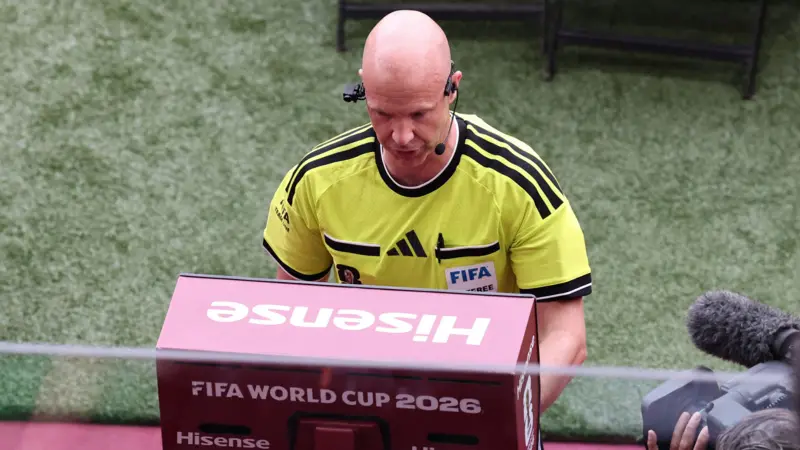
Video Assistant Referee (VAR) technology was already one of the biggest talking points at the FIFA Men’s World Cup 2026, but the debate intensified following Argentina’s dramatic victory over Egypt in the Round of 16 on July 7.
Egypt, who were leading 2-0 with just 11 minutes remaining, watched as Lionel Messi inspired Argentina to score three quick goals and complete a stunning comeback.
After the match, Egyptian players and officials expressed outrage after one of their goals was ruled out and a late penalty appeal was ignored, with VAR choosing not to intervene.
“They may have wanted the defending champions to stay in the tournament. They may have wanted Messi to remain in the race for the title,” Egypt coach Hossam Hassan said after the game.
Why Egypt Was Angry
The biggest source of controversy was the disallowed second-half goal scored by Mostafa Zico while Egypt were leading 1-0.
The goal was overturned after VAR determined that midfielder Marwan Attia had fouled Argentina defender Lisandro Martínez earlier in the attacking move.
Egypt also argued that captain Mohamed Salah had been fouled inside Argentina’s penalty area moments before the defending champions launched the attack that produced the winning goal.
However, neither the referee nor the VAR officials awarded a foul or penalty, fuelling further debate over the consistency of VAR decisions.
How VAR Works
VAR was officially introduced by FIFA in 2018 to help referees make more accurate decisions during matches.
According to FIFA President Gianni Infantino, the technology is designed to assist—not replace—match officials.
VAR allows referees to review incidents from multiple camera angles to determine whether a clear and obvious error was made in a key decision.
FIFA says the system is now used in more than 300 football competitions worldwide.
The VAR team operates from dedicated Video Operation Rooms (VOR) located away from the stadium. During the 2026 FIFA World Cup, officials have been working from the tournament’s broadcast centre in Dallas, Texas, USA.
If VAR believes an incident deserves further review, the on-field referee may be advised to watch the replay on a pitch-side monitor located in the Referee Review Area (RRA).
After reviewing the footage, the referee makes the final decision, either confirming or overturning the original call.
When Can VAR Be Used?
Before the 2026 World Cup, VAR could only intervene in four situations:
- Goals and offences leading up to a goal.
- Penalty decisions.
- Straight red-card incidents.
- Cases of mistaken player identity.
For the 2026 tournament, FIFA added a fifth category, allowing VAR to review:
- Clearly incorrect corner-kick decisions.
- Incorrect second yellow cards that result in a red card.
VAR is not responsible for determining whether the ball has crossed the goal line. That is handled by separate goal-line technology, which uses a sensor inside the match ball to send an instant signal to the referee’s smartwatch.
VAR at Recent World Cups
VAR made its World Cup debut in Russia 2018, intervening 20 times during the tournament’s 64 matches.
It led to 17 overturned decisions, including a crucial moment in the final between France and Croatia, when the referee changed a free-kick decision into a penalty after reviewing video footage.
At the Qatar 2022 World Cup, VAR intervened 27 times. In all but two cases where referees reviewed incidents on the pitch-side monitor, they changed their original decisions.
Since the expanded 2026 World Cup is still underway, complete statistics are not yet available.
However, Dale Johnson, BBC Sport’s football and VAR specialist, reports that referees had been sent to the review monitor 23 times in the first 96 matches of the tournament’s scheduled 104 games.
Only one of those reviews resulted in the referee keeping the original decision.
Johnson noted that FIFA’s Head of Refereeing, Pierluigi Collina, recently instructed officials to allow more physical play in order to improve the flow of matches.
As a result, the tournament has averaged 22.6 fouls per game, compared with 25 fouls per match in Qatar 2022 and 27 per game at Russia 2018.
Johnson argued that VAR’s decision to overturn Egypt’s goal lacked consistency with how similar challenges had been handled throughout the tournament.
“If you’re allowing those types of challenges on the field, then VAR should apply the same standard,” he said.
“I think VAR has lacked consistency, and it has become much harder to predict which incidents it will intervene in.”
However, Johnson did not believe the incident involving Mohamed Salah was as controversial.
“Salah was inside the penalty area, so VAR was assessing a possible penalty, which requires a much higher threshold of evidence to prove that a foul had occurred,” he explained.














Leave a comment