

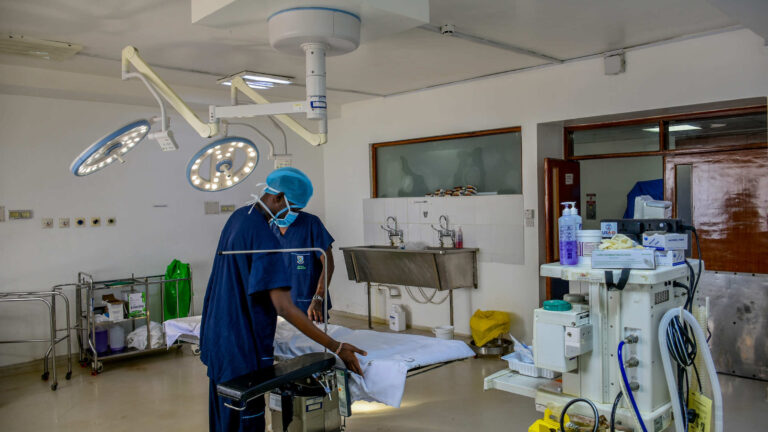
Kenyatta National Hospital (KNH) has made medical history after successfully performing Kenya’s first minimally invasive surgery to treat throat cancer, eliminating the need for major chest and abdominal incisions. The breakthrough procedure offers new hope to many patients battling the disease.
The first beneficiary of the surgery is Joshua Wanzala, who was diagnosed with Stage 2B throat cancer.
Following the operation, Joshua is recovering in the hospital’s Intensive Care Unit (ICU).
Joshua said his health problems began last year when he developed difficulty swallowing food and even saliva. Initially, he believed he had a common throat infection, but medical tests later revealed he had throat cancer.
He was referred to KNH, where he underwent 29 sessions of chemotherapy. However, his treatment was temporarily interrupted after a medical machine broke down.
Although the tumour shrank, Joshua continued to struggle with swallowing, causing his weight to drop dramatically from 80 kilograms to 40 kilograms.
“I was starving because I couldn’t swallow food,” he said.
He later underwent the groundbreaking surgery led by Dr. Joseph Mutie, assisted by Dr. Obed Makori and a multidisciplinary team of specialists.
Instead of performing a major open surgery through the chest and abdomen, the surgeons used specialized instruments and cameras inserted through small incisions, making the procedure far less invasive.
Joshua said he was surprised to find only a few small wounds after the operation and now feels much stronger, although he has not yet resumed eating normally.
He revealed that he has already spent approximately KSh800,000 on treatment but has been informed that the Social Health Authority (SHA) will cover the cost of the surgery.
According to Dr. Mutie, the procedure is suitable for patients whose cancer has not spread extensively. Its benefits include reduced pain, minimal blood loss, faster recovery, and improved surgical visibility for doctors.
During the operation, the diseased oesophagus is completely removed, and the stomach is reshaped into a tube and connected to the remaining section of the oesophagus, allowing the patient to swallow food again.
Dr. Mutie noted that patients who undergo the procedure must eat small, frequent meals that are rich in nutrients, but they can still enjoy a good quality of life after recovery.








Leave a comment