

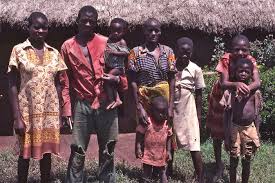
he Luhya (also known as Abaluhya, Luyia or Abaluhya)) are a Bantu speaking ethnic group comprising more than 20 related tribes. Geographically centered in the fertile Lake Victoria Basin of Western Kenya, they also maintain significant populations in eastern Uganda and northern Tanzania. They are Kenya’s second-largest ethnic group, numbering 6,823,482 per the 2019 census (approximately 14% of the national population).[2] Often described as an “ethnolinguistic constellation,” the groups include the Bukusu, Maragoli, Kabarasi, Tachoni, Wanga, and Samia, among others. Each sub-tribe maintains a distinct dialect and clan system while sharing a unified identity and common cultural institutions.[3][4][5]
The Bukusu remain the most populous tribe at 1,188,963 individuals, followed by the Maragoli (641,714) and the Idakho/Isukha groups of Kakamega (584,207). A significant trend in modern Luhya identity is the emergence of a broad, unified affiliation; notably, 1,105,308 individuals ethnically identified simply as “Luhya (So Stated)” without specifying a particular sub-tribe reflected in the 2019 Kenya National Bureau of Statistics (KNBS) report. Other major groups include the Bunyore (312,854), Marama (247,025), and the Wanga (226,358), while smaller groups like the Tiriki, Kabras, and Tachoni further enrich this constellation.[6]The autonym Abaluhya or Abaluyia is commonly glossed as “people of the same hearth” or “people of the north” in several Luhya varieties, from the root -luhya/-luyia and the plural prefix aba- meaning “people of”.[7] Individuals are OmuLuyia, the people are AbaLuyia, the language cluster OluLuyia and the imagined homeland EbuLuyia.
The term “Luhya” gained political salience in the 1940s and 1950s when colonial administrators, African politicians and mission educated elites began to group a number of western Kenyan Bantu communities together for representation in new colonial institutions. Earlier labels such as “North Kavirondo” and “Kavirondo Bantu” gave way to a more unified “Baluhya” identity in the decade before Kenyan independence.[8]
Within this broad identity, people usually self identify first by subtribe (for example Omubukusu, Omumaragoli, Omusamia) and then by clan. Luhya identity has nonetheless become important in Kenyan party politics, especially since the reintroduction of multiparty competition in the 1990s.[9] Archaeological, linguistic and genetic evidence links Luhya origins to the wider Bantu expansion from west central Africa into the Great Lakes region between roughly three and five millennia ago.[10] By the second millennium CE, Bantu speaking communities closely related to contemporary Luhya were established on the northern and western slopes of Mount Elgon, along the middle Nzoia River and in the lowlands around present day Kakamega, Vihiga and Busia.[11]
Precolonial Luhya societies were politically decentralized. Most groups lived in small clan based polities headed by councils of elders, ritual specialists and lineage leaders. The exception was the Wanga, whose kingdom under the Nabongo (king) developed a more centralized court and tributary system that interacted with neighboring Luo, Nandi and Maasai communities and later with Arab and Swahili traders.[12]
Economically, Luhya groups combined shifting cultivation of sorghum, finger millet, cowpeas and bananas with livestock herding and hunting. Iron working and pottery were well developed, and households engaged in regional exchange networks that linked the highlands to Lake Victoria and, through caravan trade, to the coast.[13]From the early nineteenth century, intensified long distance trade, cattle raiding and population movements reshaped western Kenya. Maasai and Kalenjin cattle raiding occasionally reached Luhya areas, while Luo groups expanded along the Nzoia and Yala rivers. The Wanga kingdom under Nabongo Mumia consolidated its influence through alliances, warfare and control of trade routes linking Buganda, Busoga, Kavirondo and the coast.[14]
Arab and Swahili traders reached Wanga and Samia areas in the mid nineteenth century, exchanging cloth, beads and guns for ivory and other products. British explorers such as Henry Morton Stanley and Joseph Thomson encountered Luhya communities while passing around Lake Victoria in the 1870s and 1880s, describing the region in terms that later fed into British colonial mapping.[15]With the creation of the East Africa Protectorate in 1895 and later the Colony and Protectorate of Kenya, Luhya territory was incorporated into the North Kavirondo and Elgon Nyanza districts. Colonial rule introduced new administrative boundaries, taxation, Christian missions and cash crop production.
The Wanga kingdom became an early ally of the British. Nabongo Mumia was confirmed as a paramount chief, and Wanga elders assisted in collecting taxes and labor, a relationship that brought both advantage and controversy among neighboring groups.[16] Elsewhere, Luhya communities experienced land alienation in parts of what became the White Highlands, forced labor on European farms and the recruitment of young men into the King’s African Rifles and settler estates.
Christian missions, especially the Friends Africa Mission, the Church of God, the Anglicans and the Roman Catholic Church established schools and churches in Kaimosi, Bunyore, Mumias and other centers from the first decade of the twentieth century.[17] Conversion to Christianity intersected with existing beliefs in Nyasaye/Were, ancestral spirits and ritual specialists.
Luhya soldiers fought for the British in both world wars, and many veterans brought back new political ideas and experiences. In the 1940s and 1950s, the Dini ya Msambwa religious movement led by Elijah Masinde among the Bukusu combined Christian and traditional elements with anti colonial protest and was repressed by the colonial state.[18]From the 1930s, mission schooling produced an emerging Luhya educated class that participated in nationalist politics and colonial advisory bodies. Leaders such as Masinde Muliro and Moses Mudavadi were active in the Kenya African Union and other organizations that demanded land rights, better wages and representation.[19]
The name “Luhya” was increasingly used in the 1940s and 1950s as a political category for representation in the Legislative Council and in African district associations. By the time of independence in 1963, a sense of being Luhya sat alongside strong loyalties to local subgroups such as Bukusu, Maragoli, Wanga, Banyore, Samia and others.From the 1930s, mission schooling produced an emerging Luhya educated class that participated in nationalist politics and colonial advisory bodies. Leaders such as Masinde Muliro and Moses Mudavadi were active in the Kenya African Union and other organizations that demanded land rights, better wages and representation.[19]
The name “Luhya” was increasingly used in the 1940s and 1950s as a political category for representation in the Legislative Council and in African district associations. By the time of independence in 1963, a sense of being Luhya sat alongside strong loyalties to local subgroups such as Bukusu, Maragoli, Wanga, Banyore, Samia and others.At independence, most of the Luhya population fell within the new Western Province and small parts of Rift Valley Province. Western Province became associated in popular commentary with high population density, smallholder sugarcane and maize farming, and extensive out migration to Nairobi, Mombasa and other towns.[20]
Luhya leaders played important roles in postcolonial governments. Masinde Muliro and Moses Mudavadi served as ministers in the administrations of Jomo Kenyatta and Daniel arap Moi. Later, Musalia Mudavadi, Michael Wamalwa Kijana and Moody Awori all held the office of vice president or deputy prime minister at different moments, helping entrench the idea of the “Luhya vote” as a significant electoral bloc.[21]
Political competition in western Kenya was often shaped by national party alignments rather than a single regional party. Luhya politicians appeared across the ideological spectrum in parties such as KANU, FORD Kenya, NARC, ODM and later Kenya Kwanza and Azimio formations.The 2010 Constitution of Kenya introduced a devolved system of 47 counties. Luhya populations now form majorities in the counties of Kakamega, Bungoma, Vihiga and Busia, and large pluralities in parts of Trans Nzoia and Nandi.[22]
County governors, senators and members of county assemblies from these areas have become significant power brokers in national coalitions. Wycliffe Oparanya served two terms as governor of Kakamega and was chair of the Council of Governors, while Moses Wetang’ula became Speaker of the National Assembly in 2022 and Musalia Mudavadi was appointed Prime Cabinet Secretary in the same year.[23][24]
Analysts often describe the “Luhya vote” as numerically important but politically fragmented, with different subregions and leaders backing competing coalitions in the 2007, 2013, 2017 and 2022 general elections.[25]The majority of Luhya-speaking sub-groups and tribes are located primarily in Western Kenya and consist of 17 of the approximately 20 Luhya groups in the East African region. Notably, several sub-groups share close geographic borders and cultural ties with neighboring Kalenjin-speaking communities, such as the Bukusu and Tachoni with the Sabaot, and the Tiriki and Kabras with the Nandi and Terik, leading to significant historical intermarriage and shared traditions.[1]
Significant rural Luhya populations are found in:
- Kakamega County (Idakho, Isukha, Kabras, Marama, Tsotso, and parts of Wanga and Banyore)
- Bungoma County (Bukusu, Tachoni)
- Vihiga County (Maragoli, Bunyore/Abanyore, Tiriki)
- Busia County (Samia, Khayo, Nyala, Marachi, parts of Wanga)
- Trans Nzoia County (Bukusu, Tachoni and other Luhya migrants)
- parts of Nandi County, Uasin Gishu County and Nairobi County through urban migration.
Luhya communities in Uganda live mainly in Eastern Uganda, especially in Tororo District, Mbale District and Busia District, where closely related Basamia, Banyole and Gisu (Masaba) populations reside.[26]











Leave a comment